reprinted with permission from www.workinprogressinprogress.com
Give us your elevator pitch: what’s your book about in 2-3 sentences?
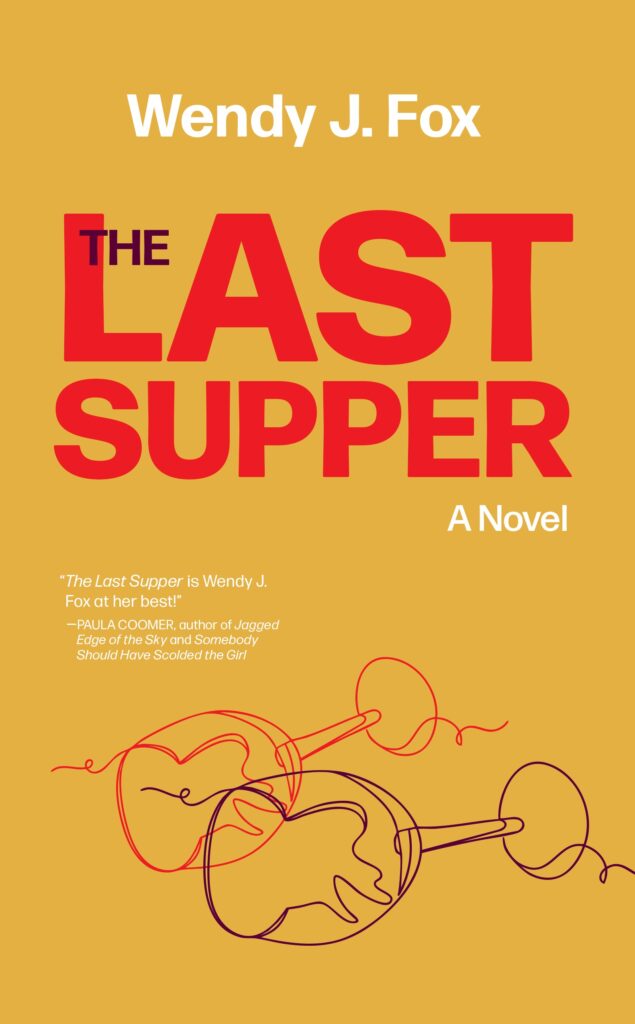
The Last Supper follows three months in the chaotic life of Amanda, who has just turned 40, has two young children, and is searching for something more in her life. She’s failed at being a momfluencer, she’s failed at MLM entrepreneurship, and she’s living in terror of what to make for dinner. Desperate for something more than the isolated world of her suburban home, but consumed by parenting, her illusory stability collapses when the cracks in her marriage finally split open so wide she sees a way out, and a pathway to reclaim her own creative and economic agency.
Which character did you most enjoy creating? Why? And which character gave you the most trouble, and why?
The character I most enjoyed creating was the mother in the novel—Camille is a successful attorney who specializes in family law and clawed her way into financial stability after being a single parent. The reason I felt energized when I was in her perspective is because she’s a successful woman who is not defined by caregiving relationships. She’s just who she is and doesn’t really care what other people think about her.
The character who gave me the most trouble—and I think this will track for other writers—was the protagonist, Amanda. She is the hinge the door of the novel hangs on, and it is from her perspective the plot unfolds.
With the most space and time with a protagonist, there’s also more chance for narrative discontinuity or character motivation issues to arise. She goes through a period of awaking in the novel, and while I think it is fair to say all writers of literary fiction or character-driven fiction want to represent the change that occurs, sometimes I have to work on not being didactic or too interior.
Still, from a process perspective, I enjoy the building of a character, inclusive of the hard parts. (This is why I don’t understand would-be creatives leaning on generative AI.)
If you can’t sit with your characters and really think about them, what’s the point?
While sure, it can be difficult, there’s also so much joy in figuring out a tricky sentence, so much satisfaction in revising a critical scene.
How I have come to think about AI chatbots (which you didn’t ask about but is on my mind all the time) is that chatbots are all output, in contrast to creative writing being largely about input.
Tell us a bit about the highs and lows of your book’s road to publication.
This is my fifth book, so at this point I can mostly roll with anything. That said, for me there is always the high of getting to contract with a manuscript, and the low of worrying about it.
The thing that has not changed at all—the thing I roll less well with is worrying how the book will be received.
I often say to people that I have this conundrum of: What if nobody reads it? And then: Oh crap, what if they do?!
Writing and publishing are just two different animals.
However, I do want to say to anyone out there shopping a manuscript: you might (will probably) at some point have a weird interaction with an agent, an editor, a publisher that will shake you. You might wake up in the middle of the night wondering if you wasted the last five years or more of your life.
It’s fine. Not every editor will get you. Lots of agents won’t. Do your work.
When you find the right publishing partner/model, you will know.
The lows are getting through the doubt. The highs are knowing you honored your work—whether it is published or not.
What’s your favorite piece of writing advice?
Over a decade ago, before I had a single book in print, I went to a panel where Andre Dubus III talked about the need for tension in every narrative.
That idea has crystallized over the years into really thinking about stakes.
On the panel, Dubus III said something like “If there’s no tension, who cares?” I think about that a lot.
My favorite writing advice is “write until something surprises you.” What surprised you in the writing of this book?
I love your writing advice.
What surprised me in writing The Last Supper was the way the manuscript changed over time. At first, I was writing from a character sketch, then I was developing in earnest. The beginning versions were very different, both in tone and plot.
But! That’s part of the whole point of the process. Which is also, again, why I can’t get down with AI, as there’s no process there.
How did you find the title of your book?
I am notoriously bad at titles.
Once, I turned in a book to my publisher called “Office Stories” – and talk about a snooze in the title department (thank goodness I was already under contract). And definitely no tension there, à la Dubus III. With some help, the title of the book became What If We Were Somewhere Else, which does have tension and also is appropriately descriptive of what it feels like to work in an office.
The title for The Last Supper came from a highly trusted reader.
I’m pretty transparent as a person and a writer, but my beta titles for what became The Last Supper are too embarrassingly bad for even me to share publicly.