By Jo Underwood
I sat down with Dan Leach for a nostalgic conversation about his 2025 Hub City novel, Junah at the End of the World, which received the South Carolina Novel Prize and the Kirkus Star. Dan Leach reaches into the heart of the cracked sidewalks of southern suburbia and pulls from it a time capsule of the small apocalypses that every child must live through. His novel, via fragmented prose, reflects the inner mind of sixth grader Junah in the face of the impending Y2K, but his masterful storytelling can only be seen as complete.
Can you talk about the setting of the novel first? You’re a southern writer, and you chose to set the novel in a neutral, “Carolina,” but while also namedropping Northwoods Middle [a middle school in Greenville]. What made you choose this small corner of South Carolina, and how did you navigate writing about somewhere you’ve lived and worked for such a large section of your life?
This is my fourth book, but I would say that this is the first one that takes place in my South. That’s a very pretentious way of saying that in my first two books, I was still writing out of the shadows of writers like Ron Rash and George Singleton. They are interested in the South, but a South that is a little more rural, a little less suburban, a little more mountainous. Whereas I grew up in the Upstate of South Carolina, and I think it just took me that time to be comfortable enough to write something that was really close to autobiography. So I attended a middle school called Northwood Middle in Greenville. The characters, the places, and the events of this novel, with the exception of two details, are drawn from my lived experience.
One of those details is Junah’s age. Junah is twelve, and in Y2K I was a little older. I fudged that because I needed him to be a little more innocent and tender. The other is the fact that the parents are divorced in the novel, whereas in my lived experience they stayed together. Except for those two details, the book functions very close to autobiography, and I think that that makes it a special book for me. Looking back, I think with my first few books I was trying to write the South of back roads and dive bars and trailer parks. I grew up around that, but I also grew up in the world that Junah moves through. I grew up in middle-class suburban neighborhoods, cul-de-sacs, shopping centers, and little league fields.
During a reading at M. Judson Books in Greenville, South Carolina, you said that Junah was “a novel about COVID disguised as a novel about Y2K.” Can you talk about the role of isolation and dread in the novel in terms of your intentions to implement both?
I think that books, in late-stage capitalism, are treated as products. There are things that you work on according to a certain set of intentions or plans, and then you produce them, and they look awfully pretty, and then they get covers and make their way to bookstores. But books aren’t really products.
In 2020, I relocated my family from the Upstate to Charleston. I was trying out a one-year contract with a liberal arts college, and I was told that it probably wouldn’t even renew because the world was ending. Nobody knew if academia, or civilization, would still be standing after 2020. I was working out of a little garage that we had all our boxes in; we hadn’t even bothered to unpack yet because we thought we would have to leave soon. And in that space, under those circumstances, I became strangely reminded of the late 1990s, which was another moment that split the country in terms of what people thought would happen, called into question the intersections of religion and politics, and really forced you to reckon with things that were outside of your control. As a kid, you’re being told that computers don’t understand the year 2000, and so planes could fall out of the sky, and Jesus might come back on a cloud. You’re not happy about it, but it’s more complicated than being afraid. You just have to sit with it and still do your daily life.
That’s what COVID felt like. It was like being a child again. We don’t know what this thing is. We don’t know where it came from. And yet we have to go on. We have to buy groceries, attend church services, work jobs, and pay bills. That sense that the apocalypse was here. I tried, in my own way, to translate that feeling into a book about Y2K.
You also have been quoted saying that Junah talks about the “Little apocalypses that every child must survive,” giving the examples of experiencing your first love, questioning your religion, or standing up to your middle school bully. How many of these small-apocalypses that Junah experiences were from yourself or a former student?
Every damn one of them. What I did in the book, and what I have so much fun doing as a writer, is creating composites. There’s a character in the book, Coach Mac. Every day after school he goes up on the roof, brings with him a box of beer, lifts weights, and listens to Clearwater Revival. The kids at the school throw rocks up at him.
Now, if the question is, “Did you actually have a coach named Coach Mac who went up on the roof, lifted weights, ripped cigarettes, and threw beer cans through the halls?” the answer would be no. But if you’re asking whether he’s a composite of different people from my past, absolutely. I actually did have a coach who was a Vietnam veteran. He teared up in front of us one day while listening to Creedence Clearwater Revival, and that memory stayed with me. I remember him talking about the song “Who’ll Stop the Rain?” and saying something like, “The rain is war. No one’s going to stop it.” Then I have this other memory of a guy I worked with on James Island who would go out onto the roof to sneak cigarettes and sneak drinks. He was this audacious figure who would drink on the roof, and everybody kind of knew it, but nobody did anything about it. So I had one memory, and then another memory, and I sort of combined those two.
Most of the characters in the book and most of the places are like that. They’re actually two or three very real people blended together. For me, that’s the easiest way to say that something is both true and fiction. People think that’s a contradiction. We’re not journalists. It’s not a matter of reportage. We’re not trying to capture exactly what happened with surgical precision. We’re trying to tell you what it was.
Can you talk to us a little bit about what your writing process was like for Junah? This novel is written in fragmented prose rather than chapters, obviously to emulate the different entries Junah is putting into his time capsule. If another writer is hoping to pull off this hybrid between an epistolary/fragmented prose novel, what craft tips do you have for making this non-traditional form work?
As George Saunders says, “Inspiration finds me at the writing desk.” I’m a big fan of structure and a big fan of discipline. But for me, the best way to write a fragment is to write across the fragments of your day. Which is to say, write at a red light. Write on the clouded door of a shower. Write in the bathroom. Write on a coffee cup. Write on scraps of paper, on the backs of receipts, in the Notes app on your phone, and in voice recordings.
To me, we live such fragmented lives. Unless you enjoy an enormous amount of privilege, most of us move through different roles, responsibilities, and spaces throughout the day. My life has always been a little chaotic. You can respond to that chaos by saying, “I don’t have time to write at all because I need a large block of uninterrupted time.” But if I took that approach, I would never write.
So my craft tip is this: you should write the way a boozehound drinks.
Have you ever known a true alcoholic? They’re always drinking. Every time they step out. Every time they pull over at a gas station. It’s in their orange juice. It’s in their milk. It becomes part of the rhythm of their day. Fragmented writing can work the same way if you’re willing to open yourself to it. You write a little paragraph while you’re stuck at a red light. You write a little scene during a fifteen-minute break between classes. Then, when you have a larger block of time, maybe you write something more developed. The beauty of fragmentation is that you can take all of these things you’ve created throughout the day and then step back and see the thematic threads that emerge. This fragment is about a crush on a girl. This fragment is about praying to God. This fragment is about a relationship with a parent. Suddenly you realize they’re all related. Then you get to take those seemingly chaotic pieces and do the real work of arranging them, almost like meticulously organizing a collage.
I think one of the deepest insecurities any writer has is reaching out for connection and worrying that someone won’t be able or willing to meet you there. The text exists in that space between writer and reader. Fragmentation pushes that relationship right to the edge because you’re relying on a certain kind of reader: a smart, careful reader who pays attention to the fragments and the ways they connect to one another.
The narrator, Junah, has a very mature and existential voice, considering the first person and epistolary format. In many ways the novel needed that mature narrator. Was this voice for Junah intentionally wise beyond-his-years, or was that something you stumbled into?
The only bad review I have on Goodreads is a single sentence: “Twelve-year-olds don’t talk this way.” And they don’t. Twelve-year-olds do not have the metaphors, the vocabulary, or some of the intellectual range that Junah has. What I’m doing here is an old trick. It’s a Catcher in the Rye trick. It’s a J.D. Salinger trick. You make the character intellectually mature, and then you make the emotional and social dimensions of that character childlike. Junah is book-smart. People-smart, no. He’s so smart that he can process his parents’ separation in terms of the subjunctive mood. But he’s also so dumb that he doesn’t know how to take his sunglasses off to talk to a girl he likes.
There’s a line from Richard Hugo that I always come back to: “The town that you put into a poem is not the town that is. It’s the town that the poem needs.” For me, this was the speaker I needed. I needed someone who was scared and emotional and vulnerable, but who was also grammatically and linguistically gifted enough to carry the book.
What is something in the novel that you wish more people would ask you about or comment on?
First, I wanted the book to feel musical. For people of my generation who grew up in the mid-’90s, one of our great currencies was the mixtape. We made mixtapes for the people we were obsessed with but were too scared to talk to. But something strange happens. At some point, you become more obsessed with the mixtape than with the person. That’s kind of Junah in a nutshell. He’s supposed to be processing reality, in this case, an announced apocalypse. But at some point he becomes really obsessed with the mixtape itself. I wanted the book to feel musical in that way. Then, later in the novel, he falls in love with this older, tougher, wiser punk girl, and she introduces him to a ton of those great punk bands of the time. That was one of the great thrills of growing up: discovering some guy from England in a leather jacket with tattoos who was voicing all the frustrations you had with the government, your parents, religion, and authority, and doing it in a way that felt exciting.
The second thing is religion. The mother in the book, not unlike my own mother, is a sort of iconic evangelical. She’s processing this announced apocalypse through the lens of Christian mindset, which was very much a part of the culture at the time. In some ways, the book is a defense of spiritual curiosity. Junah cannot accept God as God has been handed to him by his mother. She prays with him nightly. She’s pushing spirituality through this classically Southern, evangelical vocabulary: Let Him into your heart. Build a relationship with Him. Turn your life over to Jesus. Trust in the Lord. These are all clichés and platitudes that you’re bombarded with while you’re trying to figure out the world for yourself. Junah, though, is completely earnest. His mother says, “Look to God,” and he takes that literally. He goes outside and throws rocks into the sky, almost as if he’s asking, “Is there a piece of glass I need to break to have God hear me?”
Your book is published by Hub City Press, a small press located in Spartanburg, SC, home of the Converse low-res MFA program that supports this literary journal. What are some of the benefits (or drawbacks) of working with a small press?
The drawbacks are what everyone already knows: regional presses mean regional exposure. There’s no small press on earth that can compete with the Big Four. Penguin is going to be able to put your book in more places physically, but also in terms of publicity, visibility, and exposure. It’s simply a matter of resources. Hub City has three employees. That’s different from a company with three thousand people who can throw their time and expertise behind your book.
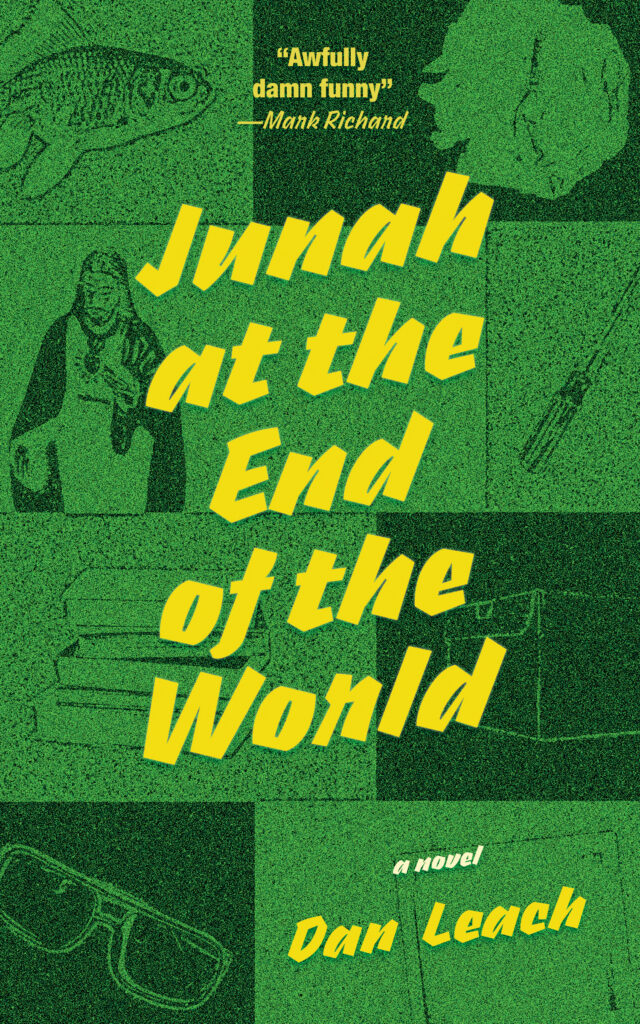
That said, within that smallness there is a level of attention and support that’s really special. Hub City, specifically, takes on projects they believe in, and they care about every step of the process from developmental edits to cover design. I had month-long conversations with them about fonts, images, colors, and design choices. We also had very intimate and fascinating conversations about the title of the book. The book was not originally titled Junah at the End of the World. It was originally titled Challenger, which is the name Junah sees on the shoebox. I suggested titles like An American Reliquary; they weren’t convinced. Then they proposed Junah at the End of the World, and I hated it. I never saw Junah’s name as the title, but this was a group of people having a genuine conversation about how to make the book better. I genuinely think it’s one of the best small presses in the country right now. Their roster is incredible, and I’m thrilled to be a part of it.
Do you believe your novel should inspire hope for people, or is it one that will send its readers further into their “world-is-ending” doom?
I hope it’s the first. The first line that ever came to me in Junah’s voice was: “Hey, Dad, do you think it’s dumb to love the world?” I wanted a protagonist who would love consistently, not someone who is constantly turning away from that. There aren’t a lot of happy literary traditions. There’s a tendency in fiction to make things more despairing, more cynical. Writers like David Foster Wallace talk about how good writing comforts the disturbed and disturbs the comfortable.
Without giving anything away, there’s a moment at the end of the book; it’s December 31st, the ball is dropping, and Junah is trying to keep his eyes open. He’s watching closely. He wants to know what’s going to happen. And that, to me, is the point: we want to know what’s going to happen.
One of the best descriptions of this I heard was, I was talking to Sebastian Smith, who is Gen Z, and I asked him what COVID did to his generation. He said, “It put a question mark at the end of every sentence.” It is no longer “I will go to college. I will get a degree. I will get married.” Now it is: “Will I?”
Everyone has some kind of “shoebox,” even if the world feels like it’s falling apart. Within this endless sea of questions, you can either shut down, or you can keep looking. I hope my novel encourages readers to keep looking.
~~~~~
Dan Leach has published poems and short fiction in The Massachusetts Review, The Southern Review, and The Sun. His most recent novel, Junah at the End of the World, won the South Carolina Novel Prize and was awarded a Kirkus star. He lives in Summerville and teaches writing at Charleston Southern University.
Jo Underwood is a writer from Greenville, South Carolina. She is an MFA candidate at Converse University. Her creative work has been featured in Ambient Heights, Trace Fossil Review, The Library of Poetry Collection, The Lindenwood Review, and Olive & Ash. She is the recipient of the 2024 Gilmore Award for Excellence in Creative Writing. When not writing, she spends most of her time teaching English or playing Dungeons and Dragons on Youtube.