
Katie Piccirillo Sherman
During this past Converse MFA summer residency, nonfiction mentor Jim Minick asked students to write a letter revealing a secret they’d never told anyone. Minick provided a number of samples, one of which was written by all-star nonfiction student Cinelle Barnes. Cinelle’s “Letter from an Undocumented” was relevant and timely. Thoughtful and heartfelt. Within it, she discussed her time as an undocumented resident and her battle for citizenship. In the interview below, Cinelle talks about that assignment and how it inevitable lead to her memoir, Monsoon Mansion, to be released in 2018.
S85: You’ve mentioned that your letter lead you down the path towards your memoir. How so?
CB: “Letter from an Undocumented” was nominated for the Journal Intro Award in 2013. It didn’t win and was never published, and so I explored what could be done to fix it. With the help of my MFA mentors, Jim Minick and Dan Wakefield, I found that my true writing voice and style were not coming through for “Letter” because there was still much to be hashed out from events preceding my years as a new immigrant. I remember Dan saying, “This isn’t done. It’s not ready to be written because there’s something else that needs to be written.”
At first I thought that writing “Letter” was such a waste of time and emotional energy, but now I understand that it had to happen. Some things you write because they’re meant to be shared publicly; other things you write to get around to the things that are meant for publishing. “Letter” was my jumping off point, and I think every creative nonfiction writer needs one. We’re all tip-toeing around THE story, and we need these little tippy-toes to inch us closer to the heart of memory and meaning.
S85: Surely you had other secrets to tell. It’s likely though that this was the most obvious and the most difficult. What made you take the leap to write about something so personal and impactful?
CB: I was in a safe space. Living as an undocumented makes you feel like you’re always being watched. But in Jim Minick’s nonfiction workshop, I met the kindest, most generous and loving people. I’ve been lucky to be a part of such amazing workshops, from my Converse College MFA group, to my Kundiman and VONA families.
S85: Was there a particular scene within the book that was more difficult than others to write?
CB: Everything was difficult to write. Every chapter involved an event that has led to my having PTSD. It was all also really difficult in that I was trying to push myself artistically in a way that I had never done before. I didn’t want to just write a trauma memoir for the heck of it, to glorify or exploit my most hurtful experiences or violence in general. I had this grand desire of creating art, of making beauty out of my ashes. For that, I had to train myself to think harder, to write descriptors with better precision, to use my training in dance and music to benefit my writing rhythm and cadence.
S85: What advice do you have for students who are also writing about a difficult subject matter?
You’ll be surprised at how many family members will cooperate and want to be interviewed. My father felt so much pride talking about all his experiences. My sister did, too. There were a few topics that were hard to talk about, but after my dad had his stroke, I remember him thanking me for having documented the good and the bad. He could’ve died or lost all his memories, but I had them recorded somewhere. Whenever it was time to get information from him again, I put on my journalist hat and forgot that he was family, that I knew the man. To me, whenever the voice recorder was on and the steno pad was out, I was no longer Cinelle, the daughter, but was Cinelle, the researcher.
S85: For fiction writers, it’s all about revealing a truth within a lie but within creative nonfiction, you’re recounting actual memories. What is the hardest thing about that?
CB: Memory can fail us. I had to do so much research to tell the story fairly and completely: vital records, photos, interviews, history books, newspapers, etc. The research itself was easy. It was in the discovery of what I didn’t already know that I cried the most. It was in the secondary trauma of reliving the darkness that I thought I would break. I had to go into intense therapy while writing the book, and I’m thankful that I did. If for anything, writing Monsoon Mansion has given me the chance to heal from memories I had repressed.
S85: Was there initially a layer of fear that held the writing back? If so, how did you overcome it?
CB: There was some fear but a lot more faith. I am also surrounded by people who never fail to pray for me, send me encouraging messages, and remind me of the power of the written word. Literature is a communal act. A writing mentor from VONA, Elmaz Abinader, once told me, “You can live a quiet life or you can do the work.” I definitely would rather do the work.
S85: You now have a very creative daughter. If you were writing a letter to her, what advice would you have for surviving a tumultuous (and somewhat anti-immigration) administration?
CB: The day Trump was elected, she ran to our bedroom saying, “Who won, Mama?” I remember telling her that he [Trump] did, in fact, win, and that I had cried about it through the night. She asked me what we would do and if we would be okay, and I told her that as long as we knew who we were, and as long as we could express ourselves, we were going to be alright. The day DACA was repealed, I explained to her what it meant for some friends and family members. She asked me what we could do to help them, and I said, “If we have to adopt every one of them, we will.”
I think raising her to have a generous, fearless spirit is the best I can do. To some degree and in a way that is not psychologically damaging, we keep her abreast of the country’s political state. It’s important to trust her intelligence and to ask her what she thinks. That way she’ll always know that her opinion matters. And the next best thing is for me to encourage her writing, drawing, and painting. It’s good for her own mental and emotional health.
About the Author
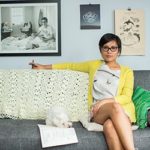 Cinelle Barnes is a creative non-fiction writer and educator from Manila, Philippines. She writes memoirs and personal essays on trauma, growing up in Southeast Asia, and on being a mother and immigrant in America.
In 2014, she was nominated for the AWP Journal Intro Award for Creative Non-Fiction, and in 2015 received an MFA from Converse College. She was part of the inaugural Kundiman Creative Non-Fiction Intensive in New York City and is an alum of the VONA/Voices workshop for political content writing at the University of Pennsylvania. Barnes was a presenter and panelist on Diversity in Literature at the Creative Writing Studies Organization Conference in 2016 (Warren Wilson College, Asheville, NC).
Her writing has appeared or is forthcoming in Literary Hub, South85, Skirt!, West Of, Your Life Is A Trip, the Piccolo Spoleto Fiction Series, Itinerant Literate’s StorySlam, and Hub City Press’s online anthology, Multicultural Spartanburg.
About the Interviewer
 Katie Sherman is a freelance journalist in Charlotte, NC. She is currently pursing an MFA degree at Converse College. She has an affinity for Southern Gothic literature, cider beer, Chicago, and morning snuggles with her girls — Ella and Addie.
 Mel Sherrer completed her MFA at Converse College in Spartanburg, South Carolina. She uses her Southern roots and knowledge of sonic aesthetic to create poems which have personal reverence for place, time, and societal evolution. Mel has been performing poetry for more than ten years. She is currently the Managing Poetry Editor for South 85 Journal, and she regularly interviews writers for our blog. She lives in Las Vegas, Nevada, where she is an avid performer, angler, and Nerf collector.
 Liz Valvano, bassoon, is beginning her Doctorate of Musical Arts in double reed performance at University of Nevada, Las Vegas. She completed her Masters in Music at Texas State University, woodwind performance under the tutelage of Daris Hale and Dr. Ian Davidson May 2017, and her BA in music and chemistry at Hollins University in May 2015, studying under Danny Felty of the Roanoke Symphony Orchestra. Currently, she performs with the UNLV Symphony Orchestra and Honors Graduate Wind Quintet.
 Caitlin Hamilton Summie earned an MFA with Distinction from Colorado State University, and her short stories have been published in Beloit Fiction Journal, Wisconsin Review, Puerto del Sol, Mud Season Review, and Long Story, Short. She spent many years in Massachusetts, Minnesota, and Colorado before settling with her family in Knoxville, Tennessee. She co-owns the book marketing firm,
 Sarah Gray graduated from Converse with a BFA in Creative and Professional Writing in 2009 through the Converse II program and stayed around to earn her MFA in Creative Writing (Fiction) at Converse as a member of the program’s very first graduating class in 2011. She founded the MFA program’s literary journal, South 85, directed the Converse Young Writers’ Workshop for two years, and served as an adjunct for three years before stepping into her current position as Associate Director of the MFA in Creative Writing program.
 M. M. Adjarian has published her creative work in such magazines as the Baltimore Review, Verdad, South 85 Journal, Eunoia Review, The Missing Slate, Serving House Journal, Crack the Spine, Vine Leaves, and Poetry Quarterly, Grub Street and Pif. When not blogging at her website,

 Michael Lee Johnson lived ten years in Canada during the Vietnam era. Today he is a poet, freelance writer, editor, publisher, and photographer who experiments with poetography (blending poetry with photography). He has been published in more than 935 small press magazines in 33 countries. For more info, visit
 Devin Murphy’s debut novel, The Boat Runner, is forthcoming with Harper Perennial/Harper Collins on September 5th, 2017. His recent fiction appears in The Chicago Tribune, Glimmer Train, and The Missouri Review, The Michigan Quarterly Review, and New Stories from the Midwest as well as many others. He holds an MFA from Colorado State University, a PhD from the University of Nebraska-Lincoln, and is an Assistant Professor of Creative Writing at Bradley University. He lives in Chicago with his wife and children.
 Marcy Posner’s editorial skill and a deep knowledge of the publishing industry sets her apart from many of her colleagues. When she work with authors, she focuses editorially on how to make the book as strong as it could be – whether that book be terrific women’s fiction or an extraordinary YA debut (or any of the other categories she represents). During that process, she is able to bring to bear all the institutional memory she possesses, knowing which editors and which publishing houses have a penchant for a certain subject, or a different voice, or a particular kind of author. Her clients include Newbery Honor winner and New York Times bestseller Jacqueline Kelly, New York Times bestseller Sheri Reynolds, autism advocate Christina Adams, Kristi Cook, Christopher Grant, Gretchen Kelley, Jerri Corgiat, former baseball pitcher Bob Tewksbury, and Marbles: The Brain Store among others.
 Katie Sherman is a freelance journalist in Charlotte, NC. She is currently pursing an MFA degree at Converse College. She has an affinity for Southern Gothic literature, cider beer, Chicago, and morning snuggles with her girls — Ella and Addie.