By Renee Kalagayan
Beth Gilstrap is many things—among them, a copywriter, an editor, an educator, a passionate mental health advocate, and a multi-genre (and inter-genre) author. She has written multiple books, and her latest one, There Is News Along the Ohio River (River River Books, 2026), is a hybrid flash creative nonfiction collection. I asked Beth some questions about the themes, techniques, and qualities of her newest book.
Give me your elevator pitch for There Is News Along the Ohio River. What is your book about in 2–3 sentences?
There Is News Along the Ohio River is my first hybrid/flash creative nonfiction book written about the period from 2020–2022 when I was living less than a mile from the Ohio River at the border between Louisville, Kentucky, and Jeffersonville, Indiana. Nearly all of it is my own experience or what I witnessed in my daily life and walks there on the pedestrian bridge that connected them. It explores place, mental illness, and the meaning of home.
You shared in a lecture at Converse University that you consider all your work to be hybrid. Could you share a little bit about the hybridity of the pieces in this book? What forms and genres are you playing around with, and how are the forms in conversation with the theme(s)?
I consider this book to be hybrid because it exists somewhere in between poetry and creative nonfiction. The pieces are all under 500 words, and short forms rely on strong imagery, lyricism, and movement. Every word is intentional. I use a lot of the tools of poetry and narrative, blending history with my own odd perception of the world due to c-PTSD. To me, genre is a set of expectations, so I suppose you can expect deep vulnerability, the story of my time there, and overall, my fierce desire to climb out of the darkness, and I hope, the same desire radiating out from all the people, places, and things that inhabit the area.
In your lecture at Converse, you mentioned that one of the most important things in hybrid and flash work is a strong title. Your title is also the first line of all the pieces in this collection. Did the pieces in There Is News Along the Ohio River all begin with the same first sentence originally, or did you discover the correlation later and write toward that end? How did you come to settle on your title?
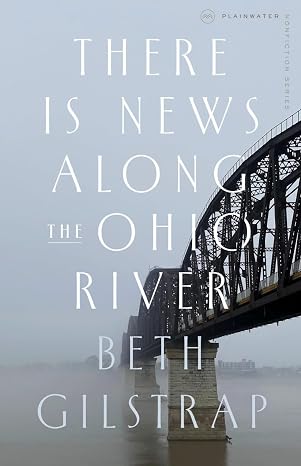
The whole book started with a sign up on the Big Four Bridge where I walked most days. It came from a newspaper article in the late 1800s—it was the headline for a disaster that occurred during the bridge’s construction when I believe it was 18 workers were killed. Every day I walked past that sign. Every day, the rhythm of those syllables bumping up against each other knocked around in my brain.
Every day I gathered images from my walks. And I just started composing these little stories in my head as I walked long before I ever put them down on paper. The title came first. The title remained the opening line for each piece. I was inspired by Terrance Hayes’s American Sonnet for My Past and Future Assassin, who repeats the same line in each of the pieces in his stunning poetry collection. I also felt like it mimicked the flow of the mighty Ohio River herself. Always moving. Always changing. Ever present. How one strip of earth could change by the day, by the hour, and hold so much. Well, I suppose that was my main inspiration because my own brain felt equally as mercurial.
Were there any boundaries or limitations you intentionally (or unintentionally) set on your work as you wrote this collection? If so, what were they, and how did they help or even hinder the creation of your book?
My mental health was spiraling during this period, and though I will always love short forms, I stripped my approach down even further for this book. Five hundred words or less. This kind of constraint set me free at this time. I could not fathom working on a long project. Or even a traditional short story. But I could get 500 words down most of the time and I kept going until I felt like I’d told the story of that twenty-one months in all its heartbreak, shame, and sadness, and joy and resilience. Like my walks along the river, writing this book was my tether to this world.
How long did it take you to write this collection?
It took me about eighteen months to write and eighteen months to find a home for it.
You mention on your website that you are “a true southern goth/punk gal at heart.” Even though the pieces in this book take place further north, would you consider There Is News Along the Ohio River a southern collection? Why or why not?
It’s a strange place there at the border between Kentucky and Indiana. It’s a borderland. Some folks call it the South. Some folks call it the Midwest. Some call it Midsouth. It felt very different to the Carolinas, and that difference helped me see all the nuances of both. I don’t know that I consider it a southern collection, but people will always call me a southern writer, for better or worse. It oozes out of my pores, the orality of my storytelling, my history—and there’s plenty of southern gothic elements floating down there by the river.
Hybrid forms are some of the most difficult to write well, but (I believe) some of the most rewarding! What possibilities does hybrid work offer writers that more rigid understandings of genre do not? How did you see these possibilities at play in your book?
I think hybrid work is a fun place to experiment and play and innovate. At the same time, I think hybrid work is also an exceptional place to work on extremely difficult material, particularly in terms of trauma. Having been at this writing practice for more of my life than not, hybridity offers me a kind of freedom that trying to stay firmly with both feet in one genre does not. I could have told the story of these two years in a more traditional memoir form, but as I said before, that kind of writing wasn’t within my capacity at that moment. There was a freedom for me in not defining what I was working on while I was working on it that I think allowed for more authenticity in expression.
~~~
Beth Gilstrap (she/her) is a multi-genre author, copywriter, editor, and educator. Her debut hybrid/flash CNF collection, There Is News Along the Ohio River, was released in February 2026 from River River Books. She is also the author of two story collections: Deadheading & Other Stories (2021), winner of the Red Hen Press Women’s Prose Prize, and I Am Barbarella: Stories (Twelve Winters Press, 2015), as well as the chapbook No Man’s Wild Laura (Hyacinth Girl Press, 2016). As a neurodivergent human who lives with c-PTSD, she is open about her struggles and fearlessly vocal about ending the stigma surrounding mental illness. She lives with her husband and a bunch of cuddly fur muppets in Charlotte, North Carolina.
Renee Kalagayan (she/her), an Asian-American writer, editor, and native South Carolinian, is an MFA candidate in poetry and nonfiction at Converse University, where she is the assistant poetry editor for South 85 Journal. Recent work is featured or forthcoming in, among others, Carolina Quarterly, The MacGuffin, HAD, Relief, About Place, and the inaugural city-wide GVL Poetry Trail in Greenville, South Carolina.
You can find Beth @bettysueblue on Instagram and on her website, bethgilstrap.com.
You can find Renee @rkalagayanpoet on Instagram, Twitter/X, Bluesky, and Facebook.