Tag Archives: #shortstories

Interview with Katrina Denza

reprinted with permission from www.workinprogressinprogress.com

Give us your elevator pitch: what’s your book about in 2-3 sentences?

The stories in BURNER explore technology’s influence on the way we communicate with each other for better or worse. Some also touch on the ways in which women are compelled to inhabit their own power in a patriarchal society.

Which story did you most enjoy writing? Why? And which story gave you the most trouble, and why?

Burner was so fun to write. Having worked in restaurants in my twenties, I know the environment and the family-like relationships that can develop. I had a great time imagining how my character might try to seduce a man who’s clearly not interested in her, and especially not intellectually. There’s No Danger Here was probably revised the most drastically. In its earliest drafts the story was over six thousand words. I chipped away at it until the narrator’s understanding of what she really wanted revealed itself.

Tell us a bit about the highs and lows of your book’s road to publication.

I sent the manuscript out to about six or seven agents and received some positive responses, but the prevailing message was that story collections are difficult to sell. At the same time, I entered the collection into contests and submitted directly to a few smaller presses. Burner was a semi-finalist in a 2023 Autumn House Press contest for fiction and longlisted for Dzanc’s 2023 contest for short story collections. A few months later, Cornerstone Press accepted it for publication. 

What’s your favorite piece of writing advice?

My favorite piece of advice is from Richard Bausch, and I’m paraphrasing here, but essentially to ground the reader in the story with details. And I also like the more general advice: write the things you’d want to read.

My favorite writing advice is “write until something surprises you.” What surprised you in the writing of this book?

My surprises show up in revision. The way I revise is probably the least efficient, which is to rewrite the story from start to finish every time, but this method tends to yield the most surprises.

How did you find the title of your book?

Burner seemed to capture the disposable nature of communication that technology encourages or allows.

Inquiring foodies and hungry book clubs want to know: Any food/s associated with your book? (Any recipes I might share?)

The chef in Burner makes a delicious coq au vin, but unfortunately, he’s as tightlipped about how he makes it as he is about himself.

Interview with Barbara P. Greenbaum

reprinted with permission from www.workinprogressinprogress.com

Give us your elevator pitch: what’s your book about in 2-3 sentences?

Go Out Like Sunday and Other Stories is a collection of sixteen short stories, featuring a cast of characters facing moments of decisive change. From a bullied boy in high school, to a couple shopping for coffins, the folks in this book face betrayal, loss, violence, grief, and yearning while dancing with the joy of new directions.

Which story did you most enjoy writing? Why? And, which story gave you the most trouble, and why?

Of all the stories in the book, I enjoyed writing Park & Ride the most perhaps because that voice came to me so easily. I instantly could hear her. And yes – I too like pickup trucks – so I had a natural affinity. And she was just so much fun!

Several stories in the book took a while to develop. Midnight Swimmer was the most emotionally difficult because it was close to the bone. I left my home in New England after being in CT for almost fifty years. It took a bit to work to get to the psychic distance I needed to tell Cynthia’s story. 

Tell us a bit about the highs and lows of your book’s road to publication.

For me, the highs and lows collided. I found out the book had been accepted for publication by Main Street Rag the Tuesday after my husband died unexpectedly during an operation. While I was thrilled that I would be working with Scott on the book, my husband’s death stopped me for a while. The last story in the book, The Midnight Swimmer, was the last story he ever read for me. I knew the story wasn’t yet finished, yet it took me almost six months after he died before I could work on it again. I was lucky enough to attend the Writers in Paradise Workshop in St. Petersburg with Stewart O’Nan specifically to get help with it. It paid off. However, it would be another year before the book felt finished to me and we could go to press. Main Street Rag‘s publisher Scott, and his wife, Jill, were incredibly understanding about my situation and waited for me. I will be forever grateful for that.

When the book finally appeared, with the cover designed by my artist friend Randy Gillman, I felt just joy that it finally happened. There is no better feeling that seeing your work in print and so beautifully done.

What’s your favorite piece of writing advice?

This one is simple for me though there are days when I don’t get there. Write every day. When I was working full time, I somehow convinced myself that I had to find an hour or two to write successfully. Then, while moaning to a friend that I could never find the time, he looked at me and said – fifteen minutes. From then on, whether I had to set the clock a bit earlier, I would write every day for at least fifteen minutes. Most often I would write before work with my first cup of tea. But I was almost immediately amazed at how much I could do in such a short period of time. And even when I had to stop, the stories and voices would often spill over into the day and those thoughts would add to the story for the next day. This helps me stay in that creative stream.

My favorite writing advice is “write until something surprises you.” What surprised you in the writing of this book?

I hadn’t realized until the collection came together how much I enjoyed playing with voices and genres. Each story in the book is very different and yet I can’t help but really like these folks. I’m so glad I got to spend time with them.

How did you find the title of your book?

I am very bad at titles. The title story of the book had a different title originally. (It’s honestly too embarrassing to name here.) The editor of the Louisville Review wrote to me to say she loved the story, hated the title. I confessed my title deficits, and she suggested Go Out Like Sunday. I loved it immediately. When I was searching for titles for the collection, I knew immediately that’s what it would be. It just felt right.

Interview with Abby Geni

by Cavenaugh Kelly

Your short story collection The Body Farm can be described as eclectic and genre defying, ranging stories about sharks, porcupines, and the neurodivergent, to the title story, The Body Farm, about a murder mystery involving a scientific research project on decaying corpses. How as a writer, do you go about researching and writing about such varied topics?

In truth, my research tends to find me rather than the other way around. I’ll be watching a documentary or browsing through interesting books at the library, and suddenly I’ll stumble across a fascinating fact about porcupines or the history of witches or the science of body farms, and down the rabbit hole I go.

I find my characters through their passions. What is the mindset of a scientist who happily studies corpses? How does someone find healing in learning about porcupines? Is it possible to work a magic spell in modern-day society? I learn what my characters know. I write about them doing what they love. That is how I discover who they are.

Can you tell us about your unique writing process, especially how you formulate everything in your head for quite a lengthy period before starting to write?

My approach to writing is almost entirely structural. I see sentences, scenes, chapters, and entire novels in terms of how they are constructed. There is a perfect architecture for each of these things, and my work as a writer is to find it. So I hold stories in my head for months or even years as I mentally put things into place. It’s like making a castle in the air. What is the staircase of the plot? What characters make up different wings of the house? What are the rooms of different chapters? Which windows look out on various scenes from the past? Just as a builder would not begin work on a house without a detailed plan, I don’t write a single word until I have a blueprint for the story in my mind.

What do you feel about the “writing rule” to only write what you know?

I love this rule, though I think it’s often misunderstood. Many people interpret it to mean Only write what you are. They feel uncomfortable writing outside their own identity; they feel it’s not okay for them to imagine the interior world of someone from a different background or race or gender.

And that’s a great instinct! We all need to be aware of our own limitations. I am a white woman who was born into a family of hippies, in the Midwest, as a part of a middle class that no longer exists. Given my own identity, I would not, for example, attempt to write from the point of view of a young Black man growing up during the early years of the Apartheid in South Africa in the 1950’s. I could research, I could interview, I could imagine, but I could never know enough to write that person’s story.

This does not, however, mean that I can only write from the point of view of people exactly like me. Sometimes I do stay very close to what I am. But other times I have traveled outside my own race, gender, background, historical context, species, and home planet. Only write what you know. The important word is know. Part of our work as writers is finding the balance between imagination and experience. If someone asks “Why are you the right person to tell this character’s story?” you must have an answer.

I knew a nurse anesthetist and pilot who said the use of anesthesia and flying were the same, it was all about the takeoff and landing. I think the same could be argued about short stories, so much is about the start and the ending. This is something that you are very skilled at doing in your short stories and I was wondering if you could walk us through your mindset when writing the start and ending to your stories, especially your skilled ability to almost dance around a great chasm of emotion but never fully give in to it.

First of all, thanks! Second of all, I totally agree. When I was a student at Oberlin College, I worked with Dan Chaon, who once told me that too many published novels could have been short stories, and that if you can write the piece as a short story, you have to.

A short story usually captures the beginning and end of a particular event: a love story, a job, a childhood, a life. That event is encapsulated in a series of scenes and flashbacks, and the reader is given enough to understand its meaning. If the story were fleshed out—if there were more scenes, more flashbacks, more characterization—the piece would become flabby and dull. It would lose its momentum and meaning. 

Novels, on the other hand, are almost entirely middle. They can’t be contained in a couple of scenes and flashbacks. I teach several classes on the novel, and one of the things I have my students do is write a synopsis of their novel. It’s almost impossible to do well, because every novel sounds insane if you summarize it. There’s just too much plot. There’s a reason novels are 90,000 words long. They can’t be shorter.

While your writing is very smooth and consistent in The Body Farm, the style, or format maybe, of the stories varies a lot. To me, as I read this, at times I felt like I was reading a more literary version of Stephen King, Roald Dahl, or even something like a Dateline episode. Where most story collections are preoccupied with relationships, I found this is to be very refreshing as a reader. What do you attribute all the different approaches to stories in this collection? Do you read widely? I know you’re a big fan of Dr. Who. Does it again go back to your wide-ranging curiosity and research?

I’ll start by saying that I was that kid who always felt annoyed that every single song on the radio seemed to be a love song. I wondered why nobody wrote songs about dinosaurs or space travel. There are a lot of brilliant short story collections out there that focus on relationships, but I would much rather focus on shark divers or serial killers.

It was my intention in this collection to play with format and style more than I ever have before. I’m fascinated by all the different ways a story can capture the reader’s attention. I love mysteries, speculative fiction, thrillers, romance, nonfiction, and graphic novels. There is so much we literary fiction authors can learn from other genres! The best mystery novels have perfect architecture. Sci-fi offers incomparable world-building. Fairy tales create childlike wonder.

All these genres filter into my work. You’re not the first person to mention Stephen King or Roald Dahl (though Dateline is new. Love it!). The title story of The Body Farm was chosen for The Best American Mystery and Suspense of 2024. I’ve been told my work is hard to classify; it often has elements of horror or mythology or thriller or mystery.

And yes, I do indeed love Dr. Who. Every story is bigger on the inside, isn’t it?

***

About Abby Geni:

Abby Geni is the author of the novels The Wildlands and The Lightkeepers and the short story collections The Last Animal and The Body Farm. Her newest novel, Children of the Wolf, will be published in the summer of 2026. Her books have been translated into seven languages and have won the Barnes & Noble Discover Award and the Chicago Review of Books Awards, among other honors. Her short stories and essays have appeared in dozens of literary publications, including Best American Mystery and Suspense, The Missouri Review, Epoch, Ninth Letter, and New Stories from the Midwest. Geni is a faculty member at StoryStudio Chicago and frequent Visiting Associate Professor of Fiction at the University of Iowa Writers’ Workshop.

About Cavenaugh Kelly:

Cavenaugh Kelly, PhD, is a writer, occupational therapist, and teacher. His short stories have been published in Slice, Harmony Magazine, Pulse, Birmingham Arts Journal, Red Wheel Barrel, Braided Way, and other publications. At Husson University, as an associate professor, Kelly teaches in the School of Occupational Therapy, winning the Theresa W. Steele award for teaching excellence in 2022, and the Global Scholar award in 2025.  He has presented, taught, and published his research on the influence of literature on the empathy levels of healthcare students internationally and nationally, winning the Global Empathy Award at the 2022 International Global Empathy Conference in London, England, where he was a keynote speaker. He is a student in the MFA program at Converse University.

Interview with Eugene Datta

by Susan Tekulve

The stories in Eugene Datta’s remarkable debut collection, The Color of Noon, are visually striking. With a painter’s eye for detail and a poet’s sensibilities, Datta summons all the senses to create the atmosphere in which his characters exist. In the story, “Rain,” the protagonist sees “scarves of rain wrapping and unwrapping themselves around a streetlamp.” In another story, “Movie Star,” Datta evokes an entire neighborhood market, where “gossip hummed like flies on the piles of mango and papaya.” In the title story, “sunlight on the window ledge is the color of noon.” Synesthetic details abound in these ten stories set in Calcutta, where characters seek relief from unrelenting noon heat in monsoon rains and darkness.

These and other images accumulate in the collection, unifying stories about characters who often live on the fringes of the city. Free of cultural norms and religious traditions, their souls are exiled and conflicted to varying degrees, their humanity exposed so the reader may see more clearly their light and dark urges. In “Hammer and Sickle,” a young female schoolteacher arranges a romantic rendezvous with an elderly Communist insurrectionist in an abandoned mental asylum. In “Movie Star,” a god-like film idol returns home to take over his father’s furniture store, becoming lusterless yet more humane as time passes. In the breathtakingly beautiful and moving story, “A Minute’s Silence,” an ailing filmmaker scripts his own dying so his son won’t be bogged down with the practical details that follow a loved one’s death. Whether they are attempting a great kindness, or suffering the effects of crime, alienation, or betrayal, Eugene Datta’s complex characters, like his images, are quietly developed. These stories seem understated at first, but upon second reading they simmer and burst with color, light, taste, and sound. 

ST: One of the more striking aspects of your writing is your command of atmospheric details. Do your stories typically arise out of place, or do they evolve out of characters and events?

ED: I like looking at things closely. The physical details of a place, for instance. Shapes, colors, the sense of space, the play of light and shadow, and so on. And I try to mentally absorb whatever I can from whatever is available—sound, smell, mood. But I’m also horribly inept and inconsistent, which means that I cannot pick up all the available information equally well. A lot of what I’m exposed to remains out of my attentional focus. And I don’t take notes. So, my mental pictures of particular places or situations largely depend on a handful of the most prominent details, which I try to describe as faithfully as I can when I write about those places/situations, or things similar to them. Now, do my stories arise out of places? Or my memory of them? Maybe they do, who knows! What I’m a bit more certain about, though, is that, when I find a character to write about, or am gripped by an image, a set of images, or an idea, I try to place them in settings concocted from my memory, or imagination, of particular places.     

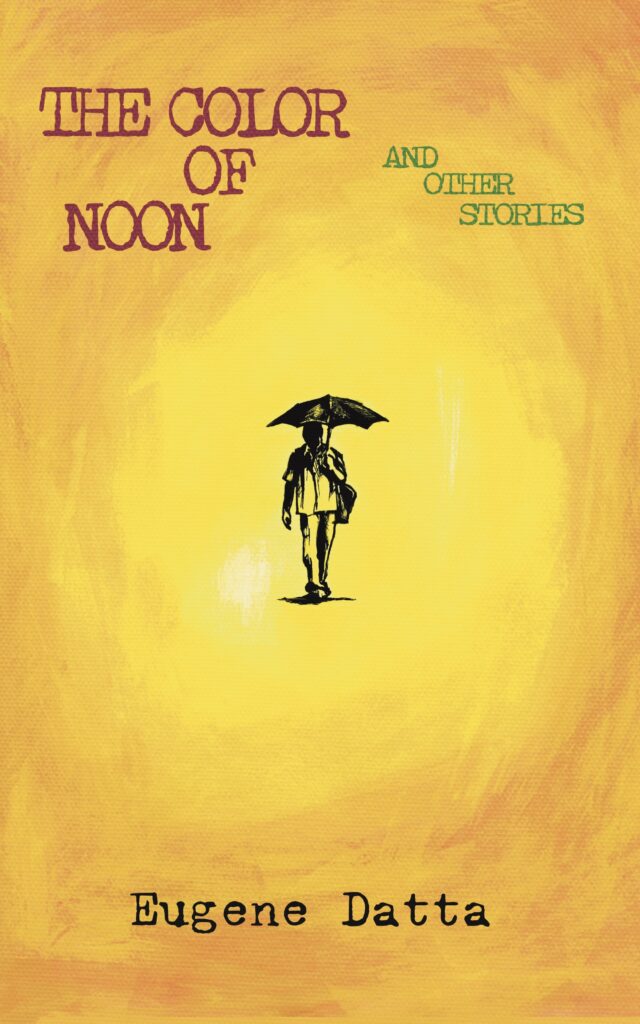
ST: I noticed you created the cover art for this book.  In what ways does your work as a visual artist influence your stories? Is there any “cross pollination” as you move between the visual arts and the literary arts? 

ED: I take interest in the way things appear, the way they present themselves to the eye. Not because I expect to find meaning there (we know that appearance doesn’t divulge essence, don’t we?), but because of the pleasure of sight, the simple yet richly sensual quality of it. Both as an image maker (artist/photographer) and a writer, part of what I try to do is describe the appearance of things, or, to be more precise, the way I receive the appearance and respond to it, and do it with as much fidelity as I’m capable of. I’m sure some cross pollination between the art forms I dabble in happens on this level, or on a much deeper one, which I cannot even pretend to be aware of. That said, I think of my fiction as being impressionistic in style, and I’m a big fan of impressionistic art.         

ST: Certain images recur and conflict with each other throughout this collection. The characters actively suffer at noon, during the heat of the day.   They find a great amount of relief from rain, and even the monsoons serve as a kind of balm or source of renewal. One of the characters in “Rain” remarks, “An hour of rain and already he’s a new man.” Is there any cultural significance, (specific to India), in the images woven through the collection? 

ED: The images represent particular ways of being—particular ways in which lives are lived within certain sections of society in a certain urban setting. I don’t think they’re representative, except in a very broad sense, even of Calcutta, where all the stories are set. On the other hand, their heterogeneity and the ways in which they often showcase particular pieces of culture, make them unmistakably Indian, or even Calcutta-specific. The image of goddess Kali in ‘Rain’, for instance, and the reverence shown to it by the teashop owner and the men the protagonist is sharing the table with, is one such detail. There’s also this loud-mouthed communist party supporter in the same scene. This, I’d say, is quite specific to Calcutta. Which, of course, is not to suggest that a scene like this couldn’t occur in Bombay or Delhi. It’s just that, it would be more “typical” of Calcutta than of any other Indian city.

Speaking of specificity of this kind, in ‘A Minute’s Silence’, the image “A koel sang in the darkness. Himadri remembered how his wife loved hearing the bird at night. Bonolota, he muttered, his eyes welling up with tears. Only darkness now….” carries a very subtle, very oblique reference to a poem titled ‘Banalata Sen’ by Jibanananda Das, one of Bengal’s greatest modern poets. Roughly translated, the final line of the poem, one of the best love poems I’ve read in any language, would read: “Only darkness remains, and Banalata Sen to sit face to face with.” (I haven’t yet come across an English translation of the poem that does justice to the Bengali original.) Unlike the poet, Himadri doesn’t have his Bonolota (although spelled differently, it’s the same name in Bengali) and is left only with darkness. The reference is almost invisible. And it’s not important at all in the larger scheme of the story. It’s like a single brush stroke in a painting with the faintest suggestion of light. It’s there just to add a subtle layer of poignancy to the image for those who notice it. And not noticing it, of course, won’t take anything away from the mood of the image. Here’s another example that’s also somewhat relevant: Toward the end of ‘Hammer and Sickle’, the insurgent says to his lover, the protagonist, “Whoever discovers the who of me…,” quoting Pablo Neruda. It’s not at all uncharacteristic of a hard-core Naxal like him to quote a foreign (Latin American or Russian) thinker or poet. Again, it doesn’t matter if someone gets it or not, but it’s a detail specific to Calcutta and its sociopolitical life in the 60s and 70s. These characters and their individual worlds are vastly different from those we find in ‘New Life’, for instance, or in ‘Movie Star’, or ‘The Color of Noon’, although all these lives and worlds are contained within a single urban universe.        

ST: How does the repetition of images (heat, rain, crows, lush gardens filled with bougainvillea and mango trees, crumbling/derelict cityscapes) help you to advance your stories, or even help you to advance the entire story collection? 

ED: The images recur because all the stories are set in one city. Although the stories themselves are very different (they’re set in different times, and are about people who’re different from one another), the recurring images run through them as a unifying thread. Also, from story to story, they consolidate (at least I hope they do) the sense of place in the reader’s mind. I didn’t, of course, think about any of this when I wrote them, which I did over several years.     

ST:  In your stories, traditional Indian mythology and religions seem to be missing from the lives of your central characters. Instead of worshipping the “old gods,” one of your characters worships an American pop star. In another story, a community of boys worship a fallen film idol.  When these new gods fail to meet the expectations of your characters, your characters appear to suffer a kind of identity crisis and extreme isolation.  Is this spiritual crisis specific to modern India, or do you believe this crisis transcends the borders of India? 

ED: I suppose it’s because I’ve always been interested in the fringes. Realities on the peripheries of dominant cultures appeal to me in a way their mainstream counterparts don’t. I’m drawn to lives in which different modes of existence blend into one another in unpredictable ways. Cultures in which the contours of behavior are not defined too rigidly, like those of objects in an impressionistic painting, if you will. Where the grip of convention is loose enough to allow a relatively free and open expression of humanity, one that’s not circumscribed by dogma or the dictates of particular traditions. As for traditional mythologies and religions, well, writers far more able than I have addressed them and used their stories more effectively than I ever could. Besides, I’m interested in other kinds of stories.

ST:  I have to admit, I knew very little about the Communist Revolution in India before reading your book. A cynical old “ex-Naxal” who considers himself a failed revolutionary appears in “Epitaph.” A “scrawny and bearded” old Communist insurrectionist hides out in an abandoned mental asylum in “Hammer and Sickle.” What questions are these stories posing about the nature of “extremism” in India? 

ED: The Naxal movement in West Bengal, in the late 60s and 70s, was spearheaded by a group of educated young men and women. They were well-read, highly motivated, and hated the bourgeoisie. Their violent insurrection was put down with equal violence. After capitulation, many of the surviving Naxals left the country and went to universities in North America. I believe the movement is alive in various parts of the country, and perhaps also in West Bengal, but I’m not sure exactly how its current iterations map onto that original movement. I’m also not sure if the book’s references to an insurgency of more than half a century ago can necessarily say anything about extremist movements in India in general. But then I’m not an expert. A historian would be better placed to answer this question. It seems to me, though, that the original Naxals were very different, given their secular education and ideals, from their counterparts elsewhere in the country both then and now.    

ST:  You were writing and publishing poetry before you published this short fiction collection.  Do you have any new projects planned in either genre?

ED: I’ve written a couple of small poems since ‘The Color of Noon’ came out. And I’m tinkering with two longer pieces of fiction. Who knows how long it’ll take me to finish them.

*****

Eugene Datta is the author of the poetry collection Water & Wave (Redhawk, 2024). He has worked as a newspaper journalist, a book reviewer, and an editor, and has had his fiction and poetry appear in publications such as Common Ground ReviewThe Dalhousie ReviewMain Street RagMantisThe Bombay Literary MagazineHamilton Stone ReviewThe Bangalore Review, and elsewhere. A recipient of the Stiftung Laurenz-Haus fellowship, he has held residencies at Ledig House International Writers’ Colony, and Fundación Valparaíso. A native of Calcutta, he lives with his wife and two children in Aachen, Germany. The Color of Noon is his first collection of stories.  

Susan Tekulve’s newest book Bodies of Light is her first full-length poetry collection. She is the author of Second Shift: Essays (Del Sol Press) and In the Garden of Stone (Hub City Press), winner of the South Carolina Novel Prize and a Gold IPPY Award. She’s also published two short story collections: Savage Pilgrims (Serving House Books) and My Mother’s War Stories (Winnow Press). Her photo essay, “White Blossoms,” appeared in Issue 12 of the KYSO Flash Anthology. Her nonfiction, fiction, and poetry has appeared in journals such as Denver Quarterly, The Georgia Review, The Louisville Review, Puerto del Sol, New Letters, and Shenandoah. Her web chapbook, Wash Day, appears in the Web Del Sol International Chapbook Series, and her story collection, My Mother’s War Stories, received the 2004 Winnow Press fiction prize. She has received scholarships from the Sewanee Writers’ Conference and Bread Loaf Writers’ Conference. She teaches in the BFA and MFA writing programs at Converse University.