By Renee Kalagayan
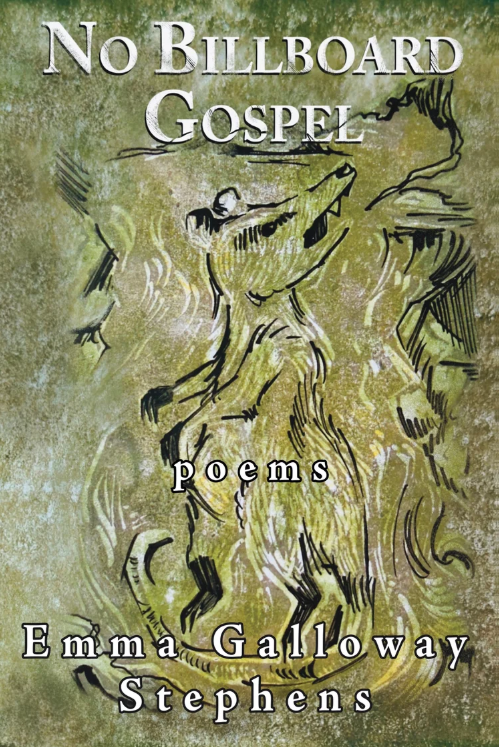
Emma Galloway Stephens is a poet, a native Appalachian, a professor of English literature and creative writing, and, most recently, a book author. Her debut collection, No Billboard Gospel (Solum Literary Press, 2026), is driven by the question, “If God exists and is good, then why does he allow evil?” Written in the Southern Gothic tradition, her poems lead readers along a kudzu-ridden, red Carolina clay path to uncover the answer. I asked Emma a series of questions that each deal with a subject, technique, or quality present in No Billboard Gospel.
This collection is very outspoken against “the commodification of faith.” I especially love your use of the term “Godhunger” to describe your insatiable drive to uncover the roots of your doubt and your anger toward injustice and hypocrisy. How have you seen faith emerge as a commodity in modern times, or even in the arts? How is poetry uniquely suited to answer this issue? Did anything ultimately quell your Godhunger, and if so, what?
I think faith, and Christianity in particular, has a centuries-long history of commodification. Christ drove out money changers from the temple. The Protestant Reformation happened in part as a response to indulgences—the church collecting money from parishioners to buy their loved ones’ passage out of hell—allowing church authorities to live in luxury at the expense of the poor worshipers. There’s a reason Jesus spent so much of his time warning against the dangers of hoarding wealth. There’s something about religion’s universality that attracts those who would use it to manipulate people. Godhunger is universal—I think we’re born craving a knowledge of something higher than ourselves. Godhunger makes us want to know and be known. It’s a good desire—but it’s unfortunately an exploitable one.
Poetry, I think, is an inherently spiritual art form, and therefore a good vessel for articulating this universal Godhunger and condemning those who would exploit it. Poetry is among the oldest art forms in human history, and we’ve used it for communicating with and about the Divine for as long as we’ve had it. It connects to the soul in the same way music does because it depends on musical conventions of patterned sound and rhythm. I think it’s significant that so many of the Bible’s books of prophecy are written in verse—poetry has always spoken truth to power. I think its inherent spirituality is part of why it’s less marketable than fiction or nonfiction—and that is a mercy. You won’t find many billionaire poets.
Godhunger is insatiable, I think. The more you know of God, the more you want to know. This unending curiosity is exciting to me. I think I’ll get many more poems out of it.
How did you select the title of your collection?
I wrote “No Billboard Gospel” (the poem) in one hour-long writing session. It’s one of the few I’ve written that arrived fully formed, and not in need of significant editing after I wrote the draft. This poem was among the last I wrote for this collection. After around two years of ruminating on its themes and images, I sneezed out a poem that summed up what I felt the collection was about—that faith is a redeeming force that crushes the sins that cripple us, and not a cheap commodity or cultural identifier or easy answer to hard questions. Up to that point, the book was called River Songs. I retitled the book to match the poem I decided was now its centerpiece.
You said in an interview with Skipjack Review that your favorite way to end a poem with a “gut punch” is to use rhyming couplets. Are there any heroic couplets in No Billboard Gospel that surprised you? Which one is your favorite?
There’s a couplet at the end of “The Devil Beats His Wife” that surprised me. It’s not quite heroic—the final line is only two iambs, not five—but most of my formal verse follows “the rules” selectively, anyway. The poem in the book is a revision of a much longer poem that I wrote in the fall of 2024. I’d sent it around to several magazines without success, so I decided to revise it a yearish later by cutting out some couplets. The line “and so’s the sky” was a new line I added after I cut whatever else I’d had after “She knows his oily well is nearly dry.” It’s a poem about the inevitable end of evil—that it’s self-exhausting and self-devouring—and will end with the same certainty that we know a rainstorm will end. I liked the parallelism it offered to the opening image.
No Billboard Gospel is rife with critters. You describe them in “Roadkill Sonnet” (my favorite poem) as “saints of every shape.” How did you come to connect animals with sainthood/priesthood? Also, St. Joan the Opossum is a recurring mascot throughout the book. How did St. Joan come to be? What is she symbolic of, or the “patron saint” of? Do you plan on writing more about her or Friar Raven in the future?
I’ve always suspected that animals intuit more about the nature of God than humans have riddled out over centuries of arguing. The idea of a possum as a kind of priest is not original to me—I got the idea from the song “Possum by Night” by The Mountain Goats, which is in the voice of a possum going about his nightly routine, calling on the bugs on his body to “praise the Lord” and naming garbage collectors “true sons of the living word.” Possums are “sin eaters” of a sort—they eat disease-spreading insects, trash, things other creatures won’t touch. They aren’t well-loved, as their appearance can be off-putting, and their lifespan is short. You’re more likely to see them dead on the road than alive in the wild. If any creature were to become a sainted martyr (venerated for their short, difficult lives; known better for their deaths than their lives), a possum fits the bill.
The name Saint Joan the Opossum is just a pun on Saint John the Apostle, the disciple who wrote the prophetic Book of Revelation. Saint Joan’s vision of God both empowers and disables her, with one eye retaining regular sight but the other going white and blind, yet able to perceive the spiritual world. In my mind, she’s the patron saint of childlike faith. Her poems are intentionally whimsical and light. Faith is as natural as breathing to her because she’s capable of understanding more than the book’s human speaker. She embodies the notion that faith can be natural and even feral.
I’ve floated the idea of a children’s book featuring St. Joan and friends, but writing for children is a precise and sacred science I’d need to take the time to learn first.
Your poems largely employ the use of form, specifically what you call “messed-up sonnets.” Can you elaborate on how form serves your work, and how it guides your writing process? Are there any forms that jump out at you in No Billboard Gospel that helped you to communicate your message more effectively? How is form in conversation with content in your collection?
I enjoy writing in forms. My best poems are “messed up”/slant sonnets. And most of those sonnets are accidental. I’ll try to write something longer, start revising, and end up with a 14-line poem with a discernable five-foot rhythm pattern, a volta, and a rhyming couplet at the end. I just like the shape and brevity of a sonnet. But I’m an imperfect formalist—the rules don’t always serve me, so I don’t follow all of them for every poem.
There are a lot of sonnets in NBG—over a quarter of the collection. Sonnets are great for creating swift, memorable impact. They’re not long; you have to be selective in the images that you choose. They require some manner of rhyme, at least at the end, which allows for the one-two punch of a rhyming couplet to the gut. The journey from beginning to end is short and satisfying, in the reading and the writing. Most of the sonnets in this collection grapple with some kind of grief. The form doesn’t prolong the grief, but contains it. I think I gravitated towards sonnets in this collection because they’re good for making difficult subjects feel more digestible.
I’ve tried to branch out to other forms, like villanelles and pantoums and sestinas. Usually they turn out stilted instead of inviting surprising revelations or phrases. One day I’ll figure out how to write well in other forms, and then I’ll be unstoppable.
You’ve mentioned to me that you have a friend who has prayed through a few of the poems in No Billboard Gospel, like a liturgy. Faith is very important to you and your work. How did your faith inform the writing of No Billboard Gospel, especially in relation to the commodification of faith and the political threads you touch on? Did any poems begin as prayers?
Most of the poems in NBG are prayers. I wrote the book when I was having a hard time praying the way I’d grown up praying—in silence, with my hands folded and eyes closed. I couldn’t sustain the practice. So I started writing poems as a way of processing what I’d wanted to pray about. “Psalm 4” became a prayer—it started as an interpretation of the images of its namesake psalm in the Bible, but became a genuine expression of my own frustration. All of the “River Song” poems, “Contusion,” the last two lines of “The Last Summer of the Kumquat Tree,” “Poetry of Witness,” “River Wade,” “March on Paris Mountain,” “The Whirlwind,” “This Feral Faith”—all [these are] prayers of a sort. I had many questions (and complaints) to bring to God, and they all took this shape.
While I wrote the poems for this book, I was assessing my faith after years of running on spiritual autopilot. The poems reflect this process of assessment—others have called this process deconstruction, but that’s not the term I prefer for my experience. I prefer restoration, which is why the last poem of the collection has that title. The more I understood about Christ—the originator and center of Christianity—the more dissatisfied I grew with how American cultural Christianity functions more like a brand identity and a useful voting bloc. Christ offers radical transformation and relationship—even friendship—with God. His promises have outlasted many empires, and will outlast today’s. I gravitated towards older expressions of the Christian faith that include liturgy, early Church creeds, and focus on the centrality of the Gospel. My faith simplified and solidified the more it engaged with Christianity’s mysteries. I’ve learned I don’t have to have all the answers. I’ve learned that loving Christ should transform me into a more loving neighbor. That perfect love casts out fear. I think the poems in NBG reflect this arc.
My favorite way you’ve ever described writing poetry is as an avenue of “soul care.” How has No Billboard Gospel served as soul care for you? What do you hope your poems do for others?
I wrote these poems as a way of sorting through my personal doubts and griefs. Writing the poems helped clear a besetting fog. My habit is to write poems about subjects that trouble or puzzle me. In this way, writing feels a bit like praying. It’s an inherently spiritual process to me.
I’ve had a reader or two tell me that my poems captured many of the complex feelings they’ve had about their faiths—I think, from their reports, that I’ve done what I set out to do. I would like those who read my poems to feel less alone in their doubts. I want them to feel hopeful in the ongoing mystery that is the process of living out our faith.
~~~~~
Emma Galloway Stephens is a neurodivergent poet and professor from the Appalachian foothills of South Carolina. Her poems have appeared in Red Branch Review, The Christian Century, Door is a Jar, Salvation South, and many others. She is a co-founder and the Educational Director of Arbor Institute for the Arts in Greenville, SC. Read more at egstephenspoetry.com.
Renee Kalagayan, an Asian-American writer and native South Carolinian, is an MFA candidate in poetry and nonfiction at Converse University, where she is the assistant poetry editor of South 85 Journal. Her work is featured or forthcoming in, among others, HAD, Relief, About Place, SoFloPoJo, and the city-wide GVL Poetry Trail in Greenville, SC. Find her on social media @rkalagayanpoet.