By Jo Underwood
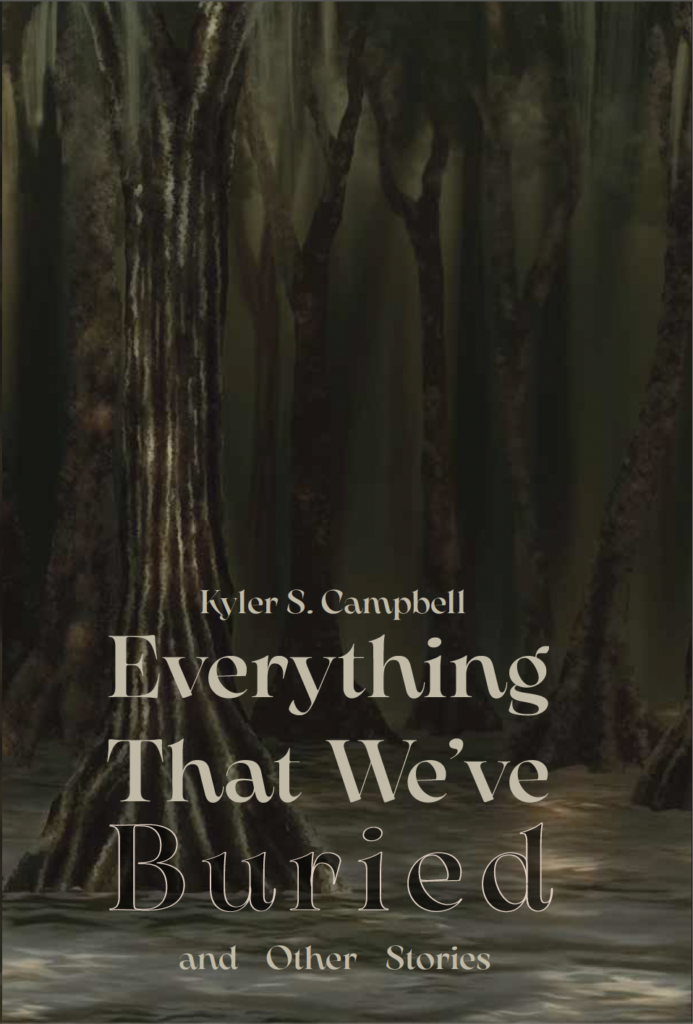
I interviewed Kyler Campbell on his debut short story collection, Everything That We’ve Buried. Campbell’s collection is set in the low country of South Carolina; he skillfully encapsulates, and diverts, Southern Lit traditions. Campbell incorporates his personal life into his work to tell stories that are both intimate and gritty, following characters that confront their faith, violence, and loss.
This is a deeply Southern collection. In writing it, were there any elements of Southern Lit traditions that you purposefully adhered to or subverted?
Adhered to, yes. Subverted, never intentionally. My first year at Converse, the best advice I got was from Marlin Barton, that “your first job as a writer is to just tell a good story.”
Flannery O’Connor said that the South is “certainly not Christ-centered. It is most certainly Christ-haunted.” That idea always stuck with me as I portrayed faith in my work. “Zombie Jesus” does that, as well as “Floodlines.” Southern fiction is about life in the South, and our experiences and trials. A lot of it is about tradition and family, too. I leaned into that a lot, especially with how family dynamics haunt the characters in “The Last Dreamer.”
That was one of the big things for me: How do family dynamics define us, and how can we redefine them to become our own person? How does religion do the same?
As for the setting, some are set in a generic South but several are implied or confirmed to be in the Lowountry of South Carolina. What draws you to writing in that setting, is it writing what you know, or is there something creatively special about the low country?
The Lowcountry of South Carolina is defined by Charleston. Nobody talks about anything that’s outside of downtown Charleston. My goal was to show that the Lowcountry is way more than just Charleston. I wanted to go into the working, blue-collar Lowcountry.
I helped my wife while she worked for the Salvation Army, and I spent a lot of time in Moncks Corner and talking to people. People who grew up in and around Huger and Cross and Eutawville, which is a little outside of Berkeley County, around the Lake Moultrie area. Their stories were fascinating. They’re quintessential, traditional Southern stories about Al Capone and The New Deal, but with their own experiences laid into them. A lot of it came from just working in the area and talking to people and not being the writer in the ivory tower, but working in a thrift shop for a while, sorting through books, sorting through memorabilia, and having conversations with people who run a bread store down off White Street in Moncks Corner or whatever else and just hearing their stories.
At a reading of “How Will They Remember You?”, you mentioned this story and perhaps others holding personal connection to your own life. Are there any stories of that personal connection that you think enrich the experience of reading your stories?
Three of them in particular connect to my life. One of them is “Zombie Jesus,” which I mentioned before, because I grew up in a very religiously intense church. The story is about a family who doesn’t celebrate Halloween and a boy who’s kind of wrestling with why, and then a father who decides to proclaim the gospel to the neighborhood with a seven-foot-tall crucifix in their front yard. That one, in particular, is very personal to me. It’s kind of a goofy story compared to the rest of them, but it still deals with some of those same themes we were talking about—religion and how religion shapes us and causes us to do wild things sometimes. That one’s born out of my own experience when I was a kid. My family and I decided one year we weren’t going to celebrate Halloween, so we put a sign out in our front yard that said, “We don’t celebrate Halloween. We celebrate Jesus.” Then we sat in the living room with all the lights out. No porch light, no interior lights, like nobody was home. People still came to our door trick-or-treating. I just remember sitting there thinking, “This has got to be weird. This can’t be normal.” My parents and I have laughed about this for a while.
The second one that is deeply personal to me is the last story, “The Last Dreamer,” the novella that’s at the end. That one, in particular, deals with the aftermath of a parent’s suicide and a kid reeling from that and trying to find his own identity through it. I’ve had a lot of mental health struggles in the past. That one, in particular, came out of a conversation with my own counselor about how suicide affects the next generation. This story was me exploring mental health struggles as a generational curse.
The third one is “How Will They Remember You?” I did a genealogy project in school and found a father son pair that were both drafted into the Confederate Army together. They ended up in a POW camp up in Maryland. During the next census, only the father is reported. Piecing it together, my professor and I realized that the son probably didn’t make it.
Most of your stories in the collection feature scenes that do not play out in order of when they occur. How do you make the decisions on when to shift the chronology and when to go into flashback?
For me, it’s just a feeling thing. Some stories need to be in chronological order. A couple of them are. One like “Chucklehead,” in particular, is just one afternoon between two brothers. For me, I like a linear story, but I also like having those gaps filled in. The flashback is always kind of essential to understand what’s going on. I think you always want to make sure that they are correlating in some way. I’m thinking about the story about the parking attendant who finds the lost little girl on Folly Beach. Every time he mentions something that’s happening in the present, we’re kind of flashing back to a relevant part of his past. The same thing for “The Last Dreamer,” the novella at the end, where you’ve got a character who’s seeing these visions of his mom in a bloody bathtub. We flash back before that, and it’s kind of, “Here’s the scene, and this is what he sees. Here’s the scene, and this is what he sees.”
As far as when to break it and when to say, “Okay, now we go to a flashback,” or, “Now we go back to the present action,” it all depends on where you feel like the story ends. There’s so much instinct in writing, and instinct comes with time. Instinct also comes with failure. The more you fail, the better your instincts get.
What is something about the collection that you hope people will notice that they may be less likely to?
I hope people notice that there is faith in this book, that there are elements of redemption, elements of forgiveness, and maybe penance in some ways, too. There are stories here that seem very anti-religion in some ways, but, like I said at the top, I’m a religious person and count myself as that. What I hope people take from it is that there is a lot of faith in this book and a lot of faith-based themes and ideas, even though it may not seem like it on the surface.
The other thing that I hope people take from this is that the Lowcountry of South Carolina is a complex place. It’s not just beaches and downtown and Francis Marion Square and all of that. It doesn’t always look the way that we want it to, but it’s still there, and it’s still kind of present and active.
I just started the MFA program from which you graduated. How did the program prepare you for writing this collection?
What the MFA program did for me was help me build habits of writing. You have to carve out that time to write. One of the things I learned going forward is that it gets more complicated as life goes on. You add in a family, you add in kids, you add in a full-time job, a second job, whatever else, and things get more complicated. But the MFA program taught me how to discipline myself and how to expect better things from myself as well, and how to push myself.
~~~~~
Kyler Campbell lives and teaches in Charleston, South Carolina. His work has been featured in Driftwood, Cumberland River Review, and elsewhere. This is his first book.
Jo Underwood is a writer from Greenville, South Carolina. She is an MFA candidate at Converse University. Her creative work has been featured in Ambient Heights, Trace Fossil Review, The Library of Poetry Collection, The Lindenwood Review, and Olive & Ash. She is the recipient of the 2024 Gilmore Award for Excellence in Creative Writing. When not writing, she spends most of her time teaching English or playing Dungeons and Dragons on Youtube.